
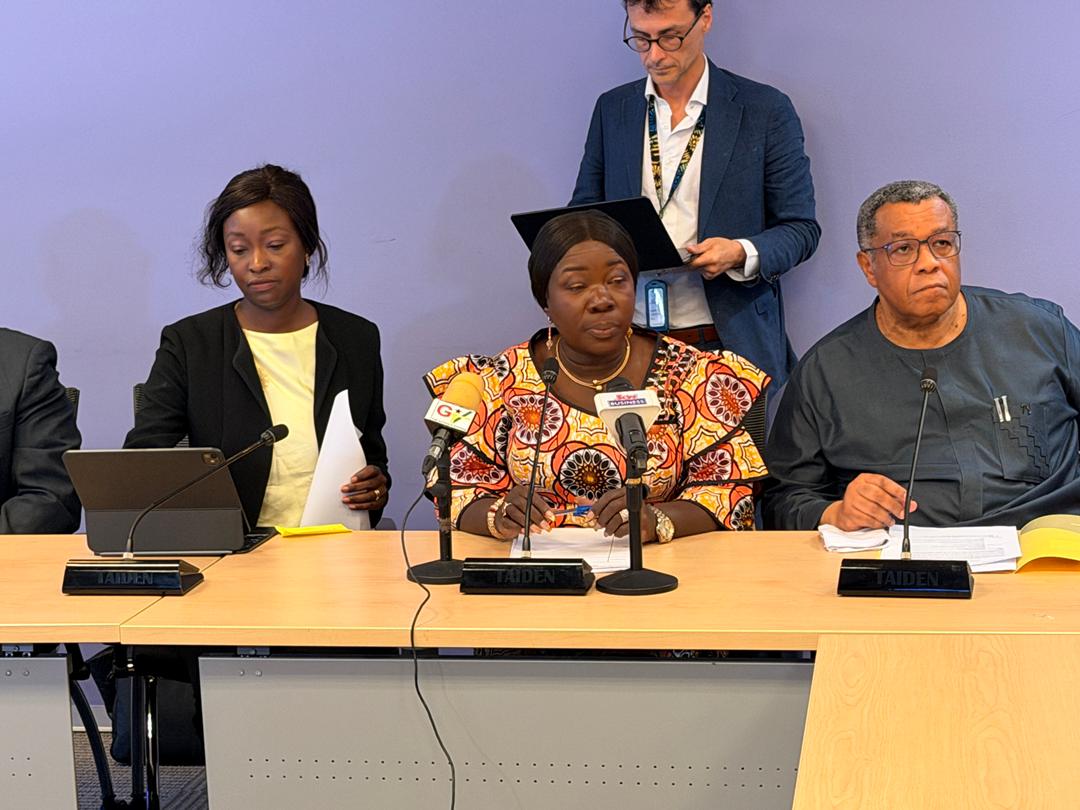
As part of efforts to unlock Ghana’s trade potential and drive inclusive economic growth, the World Bank Group Ghana Country Office, the African Center for Economic Transformation (ACET), and the Institute of Statistical, Social and Economic Research (ISSER) have held a high-level Transformation Dialogue seminar focused on strengthening trade reforms, boosting exports, and creating jobs through sustainable economic transformation.
The seminar, themed “Rethinking Trade for Growth and Jobs in Ghana,” brought together policymakers, development partners, private sector leaders, academics and think tanks to explore strategies for leveraging trade to support industrialisation, economic diversification and employment creation.
Ghana Records Historic Trade Surplus
Ghana recorded a historic trade surplus of US$13.6 billion in 2025, the strongest external trade performance in the country’s history, as government intensifies efforts to drive industrialisation, value addition and export diversification.
Minister for Trade, Agribusiness and Industry, Elizabeth Ofosu-Adjare, disclosed this during the third edition of the World Bank–ACET–ISSER Transformation Dialogue seminar.
According to the Minister, Ghana’s gross international reserves climbed to a record US$13.8 billion, while the current account balance rose from US$1.5 billion to over US$9 billion within a year, describing the gains as outcomes of deliberate reforms and disciplined economic management.
She revealed that total export receipts reached US$31.11 billion, driven largely by gold exports, which increased to US$20.98 billion following reforms introduced under the Ghana Gold Board, rising global prices and increased production volumes.
The Minister further announced that Ghana’s non-traditional exports reached a record US$5 billion in 2025, representing a 30.7 per cent increase over the previous year.
She noted that processed and semi-processed exports generated US$3.09 billion, marking a 52.78 per cent increase from 2024 levels, with cocoa derivatives including cocoa paste, butter and powder emerging as the leading earners.
“These are proof that when we add value before we export, the returns follow,” she stated. Despite the gains, the Minister cautioned that Ghana’s export base remains heavily dependent on raw commodities, stressing the need for the country to move beyond exporting unprocessed materials.
She said the government, under President John Dramani Mahama, is pursuing a deliberate strategy to build a self-reliant, import-substituting and export-led economy.
According to her, Ghana has set a target to process at least 50 per cent of its cocoa domestically, backed by installed grinding capacity exceeding 500,000 metric tonnes.
She added that similar reforms are underway in the gold sector to ensure greater value retention within the country.
The Minister explained that the government’s 24-Hour Economy programme remains central to efforts aimed at expanding productivity, deepening industrialisation and creating sustainable jobs.
She also highlighted ongoing engagements with manufacturers, exporters and trade associations to improve quality standards and address operational bottlenecks affecting Ghanaian exports.
According to her, many local processing industries continue to operate below capacity due to inconsistent supply of quality raw materials, prompting interventions to prioritise domestic industrial supply.
She identified the government’s Feed the Industry Programme as a key initiative aimed at ensuring reliable industrial-grade raw materials for local manufacturers.
On regional trade integration, the Minister disclosed that Ghana recently pushed for harmonisation of trade standards during the ECOWAS Ministers of Trade and Industry meeting in Abuja to improve competitiveness under the AfCFTA.
She also revealed that bilateral discussions were held with Côte d’Ivoire on addressing border trade compliance and operational challenges affecting trade flows between the two countries.
World Bank: Ghana’s Trade Potential Remains Untapped
The Regional Director at the World Bank Group, Seynabou Sakho, said Ghana’s trade potential remains significant but underutilised despite strong macroeconomic fundamentals.
She noted that Ghana was her first official destination after assuming office, describing the country as strategically important to the region’s development agenda.
Sakho commended government’s continued engagement on trade and transformation reforms and acknowledged the role of the 24-Hour Economy Secretariat as a key pillar of Ghana’s economic programme.
She also recognised partner institutions including ACET and ISSER, alongside stakeholders from the private sector, academia, export promotion agencies, think tanks and the media.
According to her, trade remains a powerful driver of transformation through foreign exchange earnings, productivity growth, investment expansion, technology adoption and job creation.
She stressed that Ghana is well positioned with macroeconomic stability, a dynamic private sector, a growing services sector and its hosting of the AfCFTA Secretariat, but noted that significant export potential remains unrealised.
She cited estimates suggesting Ghana has about US$12 billion in unrealised export potential, indicating the country could potentially double its exports if constraints are addressed.
Economist: Trade Gains Yet to Fully Translate Into Jobs
Senior Economist at the World Bank Group, Rami Galal, said Ghana has not yet fully realised the benefits of trade despite its strong potential.
He explained that the constraints stem from both traditional trade issues such as policy and facilitation gaps, as well as deeper structural production challenges.
According to him, while earlier periods showed positive contributions from net exports to economic growth, recent years indicate a reversal, with net exports negatively affecting GDP growth.
He highlighted limited dynamism in Ghana’s export sector, where a small number of large firms dominate while entry and survival rates for new exporters remain low.
He also cited non-tariff barriers, logistics inefficiencies and border delays as major drivers of trade costs.
Structurally, he noted that Ghana’s export base remains narrow and dominated by gold, oil and cocoa, with limited diversification.
He added that manufacturing remains relatively small, limiting broad-based industrial job creation, while services exports, particularly digital services, are emerging as new opportunities.
ISSER Calls for Structural Export Reforms
Director of the Institute of Statistical, Social and Economic Research (ISSER), University of Ghana, Robert Darko Osei, said countries that are more trade-intensive tend to record lower poverty rates when trade is properly structured.
He explained that trade not only drives economic growth but also creates employment and reduces poverty when linked to productive sectors.
However, he noted that Ghana’s export structure has remained largely unchanged over time despite increased trade since the early 2000s.
He said the complexity of exports has not improved significantly, with Ghana still heavily reliant on raw commodities such as cocoa, gold and oil.
He observed that even with oil added to the export basket, the structure remains broadly similar in terms of value addition.
He stressed that attracting the right type of investment is essential to ensuring trade translates into jobs and poverty reduction.
He warned that geopolitical shocks make diversification even more urgent, as over-reliance on a narrow export base increases vulnerability.
He noted that regional trade frameworks such as ECOWAS and AfCFTA have not yet achieved full effectiveness due to implementation gaps.
He also pointed to high effective tax rates, high cost of credit driven by non-performing loans, and persistent non-tariff barriers as key constraints affecting competitiveness.
He identified infrastructure gaps across the region as a major challenge to cross-border trade.
He further noted that energy reliability and cost remain critical issues, forcing many SMEs to rely on generators, thereby increasing production costs.
He added that renewable energy solutions such as solar remain expensive upfront, limiting adoption.
He concluded that fiscal pressures, infrastructure deficits and energy challenges are interconnected structural issues that must be addressed to unlock trade-led job creation.
GEPA Highlights SME Export Challenges
The Deputy Director of Research at the Ghana Export Promotion Authority, Dr. Martin Akogti, said export data confirms extreme concentration in Ghana’s export sector.
He explained that out of more than 1,200 exporting firms, only 111 companies account for about 80 per cent of export earnings.
He said many SMEs enter the export sector without adequate preparation, often driven by one-off export orders they are unable to sustain.
He stressed that exporting is a complex process requiring proper systems, structure and readiness.
According to him, many SMEs lack internal capacity, planning systems and export knowledge, resulting in high failure rates.
He said GEPA has introduced the Ghana Export School to build exporter capacity and improve readiness for international markets.
He highlighted production constraints, especially the inability of SMEs to aggregate supply and meet large export orders.
He identified financing as a major barrier, noting that export activities are highly capital intensive.
He urged SMEs to collaborate and form partnerships to meet large container orders instead of operating individually.
He added that non-traditional exports remain a strong pathway for inclusive growth, particularly in agro-processing, garments, handicrafts and trading services.
He disclosed that trading services are projected to reach US$10 billion, reflecting the sector’s growth potential.
He concluded that despite the challenges, the non-traditional export sector remains a viable engine for job creation and inclusive development.
Goosie Tanoh Pushes Structural Reforms
During a panel discussion, Presidential Advisor on the 24-Hour Economy at the Office of the President, Goosie Tanoh, said Ghana’s export structure remains highly concentrated in a few commodities.
He noted that the economy continues to depend on gold, oil and cocoa, replacing earlier reliance on timber.
He stressed that financing gaps, weak supply chains, low agricultural productivity and institutional inefficiencies remain major barriers to diversification.
He highlighted logistics costs, noting they account for between 40 and 60 per cent of final product prices.
According to him, the 24-Hour Economy programme is designed to modernise production systems, improve logistics, strengthen supply chains and develop human capital.
He emphasised agriculture and manufacturing as key pillars for inflation control, import substitution and export growth.
He also stressed the importance of regional trade under ECOWAS and AfCFTA, while encouraging exploration of new markets in Asia and other regions.
He added that a Presidential Advisory Committee on Accelerated Export Development has been established to coordinate reforms across key institutions.
He concluded that Ghana’s transformation depends on coordinated reforms across infrastructure, agriculture, manufacturing, logistics and skills development.
Digital Economy Sector Targets Massive Job Creation
Executive Officer of the Business Outsourcing Services Association Ghana, Mr. Gowu, said Ghana’s most valuable export asset is its human capital.
He explained that Ghana has a growing pool of young, educated and tech-skilled graduates, producing over 120,000 graduates annually alongside a talent base of more than 800,000 trained young people seeking opportunities.
He said Ghana is already ahead of many regional peers in digital skills and English proficiency, making the country attractive for digital services outsourcing.
According to him, international companies have already established operations in Ghana, employing thousands of young people to deliver global digital services.
He, however, noted that Ghana is not yet deliberate enough in positioning itself as a global digital services export hub.
He described digital service exports as the ability for companies to outsource work remotely to Ghanaian talent, generating income and foreign exchange.
He added that high real estate costs remain a major barrier for outsourcing firms, with some costs comparable to global cities such as New York.
He disclosed that some global service providers have already employed more than 2,500 young people in Ghana and are planning expansion.
He further revealed that the 24-Hour Economy Secretariat is supporting a programme known as ASPIRE 24, which is conducting feasibility studies aimed at positioning Ghana as a digital services hub.
He said plans are underway to develop large-scale infrastructure hubs with capacities exceeding 3,000 seats near universities to tap into graduate talent.
He added that regulatory reforms are also underway, including the removal of high capital requirements that previously discouraged smaller foreign firms from establishing operations in Ghana.
He stressed that Ghana must deliberately market itself as a digital services destination, just as it promotes sports and other sectors.
He noted that Ghana already has nearly half a million young freelancers working on global platforms such as Upwork, but said the formal digital outsourcing economy must be expanded.
READ ALSO: Cedi Printing Costs Halve Despite Rising Cash Demand in Ghana
According to him, formalisation would help improve tax revenue mobilisation and strengthen financial tracking of digital income flows.
He set a target for the sector to create more than 100,000 formal jobs within five years if properly structured.
He also called for stronger promotion of Ghana’s innovation hubs, increased inbound investor engagement and participation in global trade fairs.
He concluded that Ghana is well positioned for export growth in both traditional and digital sectors if deliberate policies are implemented.
He further noted that while Ghana faces the challenge of absorbing more than 120,000 graduates annually, institutions such as the interstate employment system currently employ close to 60,000 people, highlighting the scale of the employment gap.
Source : Isaac Kofi Dzokpo
