
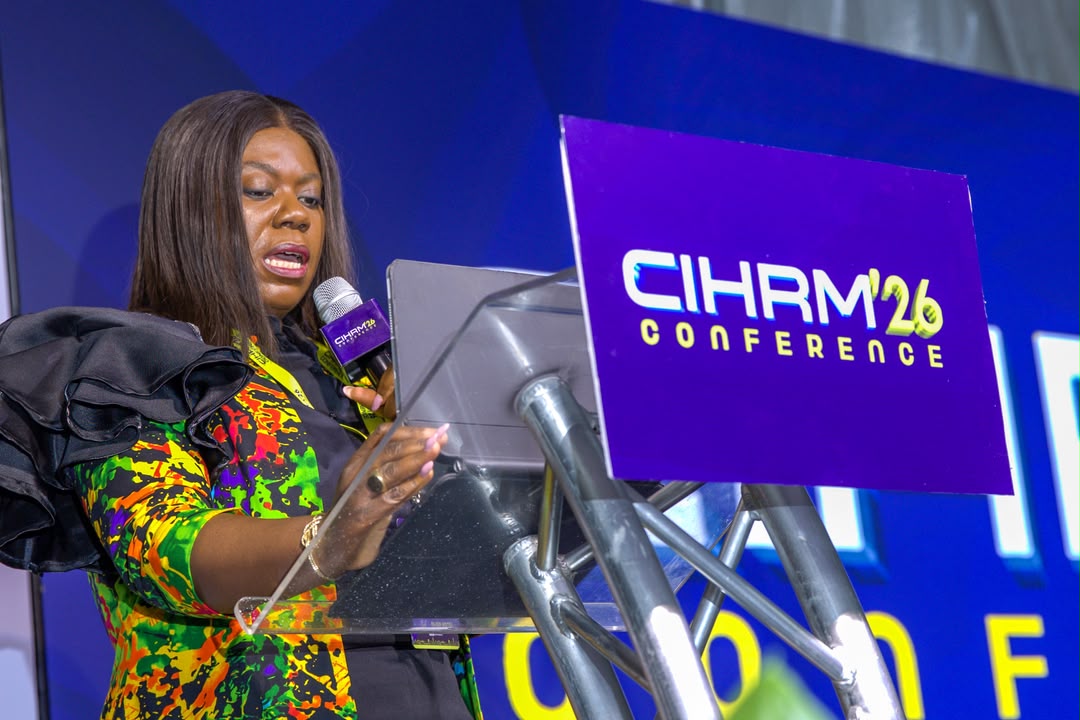
The Chief Human Resources Officer of MTN Ghana, Esi Mmirba Wilson, has underscored the need for workforce transformation to help organisations adapt to the rapid changes being driven by artificial intelligence (AI), digital innovation, and evolving employee expectations.
She said businesses can no longer rely on traditional workforce models and must instead embrace continuous learning, skills development, and organisational agility to remain competitive in an increasingly technology-driven world.
Speaking at the 2026 Chartered Institute of Human Resource Management (CIHRM) Conference in Accra, held on the theme, “Advancing Human Resource Excellence in Ghana: Leadership, Technology and Governance,” Ms. Wilson noted that the future of work is no longer a distant concept but a present reality that requires decisive action from employers and human resource professionals.
Addressing the session on the topic, “HR Transformation in the AI Era: Technology, Future Skills, and the New Employee Value Proposition,” she urged HR leaders to move beyond administrative functions and take on a more strategic role in shaping organisational transformation.
“The question is no longer whether AI will transform work. It already has. The real question is whether our people, organisations and HR systems are ready to lead that transformation,” she stated.
According to her, global labour markets are undergoing significant changes as technological disruption, economic uncertainty, geopolitical tensions, and shifting social expectations redefine the way businesses operate.
She cited findings from the World Economic Forum’s 2025 Future of Jobs Report, which projects that 22 percent of jobs will be disrupted by 2030, while nearly 40 percent of current skills will either become obsolete or require significant updating.
Ms. Wilson stressed that the evolving business environment demands resilient and adaptable workforce systems capable of responding effectively to constant change while maintaining productivity and employee well-being.
Drawing on MTN Ghana’s experience over nearly three decades, she said the company’s success has been driven not only by technological innovation but also by employees who have consistently embraced change and developed new capabilities.
“Technology alone does not transform organisations. People do. Every milestone we have achieved has been powered by a workforce willing to learn, adapt to change and lead through transformation,” she said.
She noted that emerging technologies such as AI copilots, automation tools, and intelligent digital assistants are already enhancing productivity and transforming workplace operations across industries.
However, she cautioned that organisations must pay equal attention to issues such as data privacy, responsible AI use, algorithmic bias, digital inclusion, and ethical governance to ensure technology benefits both businesses and employees.
Ms. Wilson observed that traditional job descriptions are gradually giving way to skills-based workforce models, where adaptability and continuous development are becoming more important than fixed roles.
She identified data literacy, AI fluency, digital agility, critical thinking, adaptive leadership, ethical decision-making, and cross-cultural communication as some of the key competencies that will shape success in the future workplace.
“The half-life of skills is shrinking rapidly. Organisations can no longer depend solely on recruitment. They must continuously build, refresh and redeploy skills from within,” she emphasized.
She therefore encouraged organisations to invest heavily in reskilling and upskilling programmes, workforce capability assessments, and learning platforms that enable employees to remain relevant in a changing economy.
Ms. Wilson also highlighted changing employee expectations, noting that workers increasingly seek purpose-driven careers, professional growth opportunities, flexibility, inclusion, and workplaces that support their overall well-being.
She said organisations that fail to respond to these expectations risk losing talent in a highly competitive labour market.
“The employee value proposition that attracted talent a decade ago is no longer sufficient. The workforce has fundamentally changed, and organisations must evolve with it,” she said.

According to her, MTN Ghana’s purpose of harnessing technology as a force for good continues to guide its people strategy, helping employees connect their work to broader goals of digital inclusion, national development, and shared prosperity.
She urged HR practitioners to position themselves as transformation partners capable of helping organisations navigate uncertainty, unlock employee potential, and build future-ready institutions.
READ ALSO: MobileMoney Fintech Ltd’s Extraordinary General Meeting Slated for June 12
“The future of work is already here. HR must not merely respond to change; it must lead it. We must build organisations that invest in people, unlock potential, and drive lasting impact,” she stated.
Ms. Wilson further called for sustained investment in digital skills development, AI readiness, and lifelong learning to ensure workers are equipped to thrive in an increasingly technology-driven economy.
The CIHRM 2026 Conference brought together human resource practitioners, business leaders, policymakers, and industry experts to discuss emerging trends shaping the future of work and human capital development in Ghana and beyond.
The event was supported by Jobberman Ghana, OmniBSIC Bank, HRCC Consulting Group, Ghana Airports Company Limited, Ghana Gas, and the Electricity Company of Ghana.
Source: Isaac Kofi Dzokpo
