

The Special Prosecutor, Kissi Agyebeng, has called for stronger constitutional and legal safeguards to protect the Office of the Special Prosecutor (OSP), stressing that the fight against corruption in Ghana must be anchored on institutions that are independent, stable, and resilient to political change.
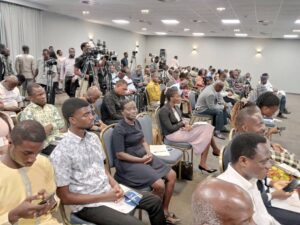
He made the appeal at a National Dialogue on the OSP organized by the Center for Democratic Development, Ghana, which brought together governance experts, civil society actors, and development partners to assess the progress, challenges, and future of the country’s anti-corruption framework.
The dialogue focused on strengthening accountability systems in Ghana and ensuring that institutions created to combat corruption are not weakened by shifting political interests.
Growing Trust in Anti-Corruption Efforts
Mr. Agyebeng highlighted that the OSP has made notable progress in fulfilling its mandate, particularly in investigating and prosecuting corruption-related cases.
He noted that public confidence in the institution has increased significantly over the years, with many citizens expressing trust in the OSP’s ability to pursue corruption cases more aggressively than other accountability bodies.
According to him, this growing trust reflects a broader demand from the public for stronger enforcement of transparency and accountability in governance.
He described the development as an important milestone, but cautioned that public confidence alone is not enough to guarantee the survival and effectiveness of the institution.
Concerns Over Institutional Stability
Despite the gains, the Special Prosecutor expressed concern about the long-term sustainability of the OSP, warning that its existence should not depend on political discretion or goodwill from those in power.
He indicated that discussions in the past have included proposals to restructure or even abolish the office, raising concerns about its future stability.
Mr. Agyebeng stressed that such uncertainty undermines institutional confidence and could weaken the broader national fight against corruption if not addressed through legal reforms.
He emphasized that accountability institutions must be designed in a way that allows them to function independently, regardless of changes in government.
Call for Constitutional Safeguards
The Special Prosecutor urged stakeholders to prioritize constitutional and legislative reforms that would entrench the independence of the OSP.
He explained that without strong legal backing, anti-corruption institutions remain vulnerable to political pressure and administrative interference.
According to him, embedding clear protections in Ghana’s constitutional framework would ensure continuity, strengthen enforcement capacity, and build long-term public trust.
He also cautioned against designing reforms based on individual officeholders, arguing that institutions must be strengthened based on principles rather than personalities.
Civil Society’s Role in Accountability
Mr. Agyebeng also called on civil society organizations, the media, and citizens to play a more active role in safeguarding accountability institutions.
He said civil society remains a key partner in ensuring that the gains made in the fight against corruption are preserved and expanded.
According to him, sustained civic engagement is necessary to prevent regression and to ensure that institutions like the OSP remain effective and independent.
He stressed that the fight against corruption cannot be left solely to state institutions but must involve collective national responsibility.
Constitutional Review as a Key Opportunity
The Special Prosecutor identified the ongoing constitutional review process as a critical opportunity to strengthen Ghana’s anti-corruption architecture.
He urged policymakers and stakeholders to ensure that recommendations aimed at reinforcing the OSP are properly incorporated into the review process.
He described the moment as a rare chance to secure the legal foundation of the institution for future generations.
According to him, decisions taken during this period will have long-term implications for governance, accountability, and public trust in state institutions.
Background and Broader Context
The Office of the Special Prosecutor was established as part of Ghana’s broader efforts to combat corruption and improve transparency in public administration.
Over the years, the institution has played a key role in investigating allegations of corruption involving public officials and state institutions.
However, like many anti-corruption bodies globally, it has faced challenges related to funding, independence, political pressure, and operational capacity.
These challenges have often sparked public debate about how best to strengthen such institutions to ensure they remain effective and insulated from political interference.
Implications for Governance in Ghana
Observers say the concerns raised by the Special Prosecutor reflect a broader governance challenge in Ghana how to build strong institutions that can withstand political transitions while delivering accountability.
If strengthened through constitutional reforms, the OSP could become a central pillar in Ghana’s anti-corruption framework.
However, failure to secure its independence could weaken public trust in accountability systems and slow progress in the fight against corruption.
Governance analysts argue that the credibility of anti-corruption efforts depends not only on enforcement actions but also on the stability of the institutions carrying out those functions.
READ ALSO: Strong Buffers, Low Credit Costs to Power Ghana’s Growth — BoG
What Lies Ahead
Attention is now expected to shift to Parliament and constitutional review processes, where key decisions about the future structure and protection of the OSP may be considered.
Civil society groups are also expected to increase engagement, following the Special Prosecutor’s call for stronger civic involvement in safeguarding accountability institutions.
As Ghana continues to strengthen its governance systems, stakeholders say the focus will be on ensuring that anti-corruption institutions are not only effective but also durable and independent. For the Special Prosecutor, the message is simple: Ghana’s success in tackling corruption hinges on how effectively the country safeguards the institutions tasked with ensuring accountability.
By Margaret Esaah Boakye
