
A technical failure rooted in decades-old infrastructure, not human interference or sabotage, caused the April 23 fire at the Akosombo Substation, according to findings of an investigative committee tasked with determining the origin of the incident.
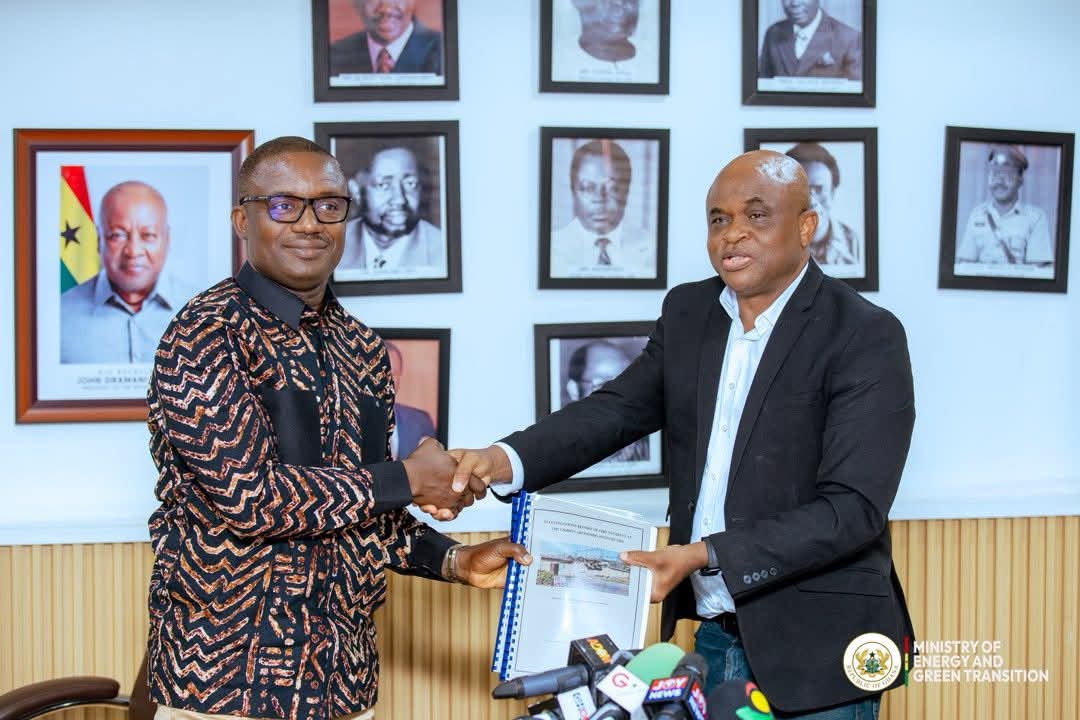
The report, presented to the Minister for Energy and Green Transition, John Abdulai Jinapor, has shifted national attention away from speculation about deliberate action and instead placed a spotlight on a far more systemic challenge: the gradual deterioration of Ghana’s power transmission infrastructure.
At the centre of the incident was a failure in insulation within ageing low-voltage cables located in the substation’s changeover panel. Over time, engineers say, the cables had become brittle due to prolonged exposure to heat, load stress, and operational aging. When the insulation finally failed, it triggered an electrical fault that set off a chain reaction culminating in fire.
Chairman of the committee, Engineer William Amuna, explained that the fire did not originate from external interference, but from within the system itself.
“The fire started from insulation failure in the LV panel and not because anybody tampered with the system,” he stated, underscoring that investigations found no evidence of sabotage or human wrongdoing.
A Chain Reaction Inside a Critical Power Hub
The Akosombo Substation is a key node in Ghana’s national electricity transmission network, handling multiple outgoing circuits that distribute power across significant parts of the country. According to the committee’s technical breakdown, the failure began when faulty insulation allowed current to flow abnormally within the system.
Initially, the Akosombo powerhouse detected the anomaly and automatically tripped at 311 amps. However, a second transformer—configured to withstand a higher threshold of 450 amps—immediately took over the load. This backup mechanism, designed to ensure continuity of supply, unintentionally worsened the situation.
With electricity continuing to flow through the damaged section, heat levels rose rapidly. The combination of sustained current and deteriorating insulation eventually ignited the cables, allowing flames to spread through interconnected control systems within the facility.
Engineers noted that the design of the substation, while functional for its time, contributed to the rapid spread of the fire. Multiple panels and control cables were closely integrated, a configuration that amplified the impact once the fault escalated.
Aging Infrastructure Under Pressure
The findings have reignited long-standing concerns about the condition of Ghana’s electricity transmission network, much of which was constructed decades ago and has not undergone full-scale modernization.
Experts within the energy sector have repeatedly warned that increasing demand, coupled with aging equipment, places the national grid under mounting stress. While maintenance routines exist, the scale of infrastructure replacement required has often lagged behind operational needs.
The Akosombo incident has now become a stark illustration of those warnings. Engineers described the affected cables as having “gone brittle,” a condition that typically develops after years of continuous load exposure without full replacement.
The committee’s report also highlighted how interconnected systems within large substations, while efficient for distribution, can pose risks when one component fails. In this case, once the fire started, it spread quickly across adjacent panels and control lines, complicating containment efforts.
Immediate Response and System Recovery
Despite the severity of the fire, restoration efforts were initiated shortly after the incident. GRIDCo and the Volta River Authority (VRA) implemented emergency protocols to reroute protection and control functions directly from the Akosombo Power Plant.
According to the committee, this temporary arrangement is expected to be fully operational by the end of August, ensuring stability while permanent repairs and upgrades are planned.
The swift response helped limit prolonged nationwide disruptions, though parts of the country experienced temporary power instability following the incident.
Government Response and Policy Implications
Receiving the report, Energy and Green Transition Minister John Abdulai Jinapor described the incident as a critical warning for the sector. He assured that government would carefully review and implement the committee’s recommendations.
“We will digest all the contents of the report and implement it to the letter,” he said.
Beyond immediate repairs, the Minister emphasized accountability and long-term reform, noting that any negligence uncovered would be addressed. More importantly, he framed the incident as a catalyst for broader structural improvements in Ghana’s energy infrastructure.
“This should be a wake-up call for us so that we can strengthen the system, improve our maintenance culture and invest in the grid to build a more resilient energy sector,” he stated.
What Comes Next: A Turning Point for Ghana’s Power Grid?
The committee has recommended both short-term stabilisation measures and long-term infrastructure renewal. Among the most significant proposals is the construction of a modern control facility to replace the ageing substation infrastructure.
The proposed design is expected to mirror the Pokuase Substation, a more modern facility widely regarded as a benchmark for improved safety standards and operational efficiency. If adopted, the new control centre could take between 18 and 24 months to complete.
Energy analysts say the Akosombo fire could become a defining moment for Ghana’s power sector, depending on how decisively authorities act on the recommendations. While immediate technical fixes are already underway, the deeper challenge lies in financing and executing large-scale grid modernization.
There is also a broader policy question: whether Ghana’s energy planning has sufficiently accounted for the hidden risks of aging infrastructure in a system increasingly expected to support industrial expansion, digital services, and population growth.
A Broader Lesson for Energy Security
Beyond Ghana, the Akosombo incident reflects a wider challenge across many developing economies—how to balance expanding electricity demand with aging transmission assets that are often expensive to replace.
READ ALSO:Bawumia Signals Cocoa Policy Reset After Farmers’ Complaints
As countries push for reliable power to support economic transformation, the integrity of transmission infrastructure is becoming as important as generation capacity. Failures like the Akosombo fire demonstrate that even well-designed power systems can become vulnerable when maintenance cycles fail to keep pace with physical deterioration.
For Ghana, the conclusion of the investigation brings clarity but also urgency. The fire may have been contained, but the underlying issues it exposed remain unresolved.
What happens next—how quickly upgrades are implemented, how effectively funding is mobilized, and how rigorously standards are enforced—will determine whether the incident becomes just another technical report or a turning point in the country’s energy future.
