
The sharp appreciation of the Ghana cedi has tempered what would otherwise have been substantial gains for investors in the Ghana Gold Coin, even as global gold prices have surged to record levels.
Since the coin began official trading on November 28, 2024, investors have posted solid returns, primarily driven by the international gold market. However, the strengthening of the local currency has offset a portion of these gains, moderating returns when measured in cedi terms.
The performance of the Ghana Gold Coin, issued by the Bank of Ghana (BoG), is influenced by two main factors: the global gold price, particularly the benchmark set by the London Bullion Market Association (LBMA), and the exchange rate between the US dollar and the Ghana cedi.
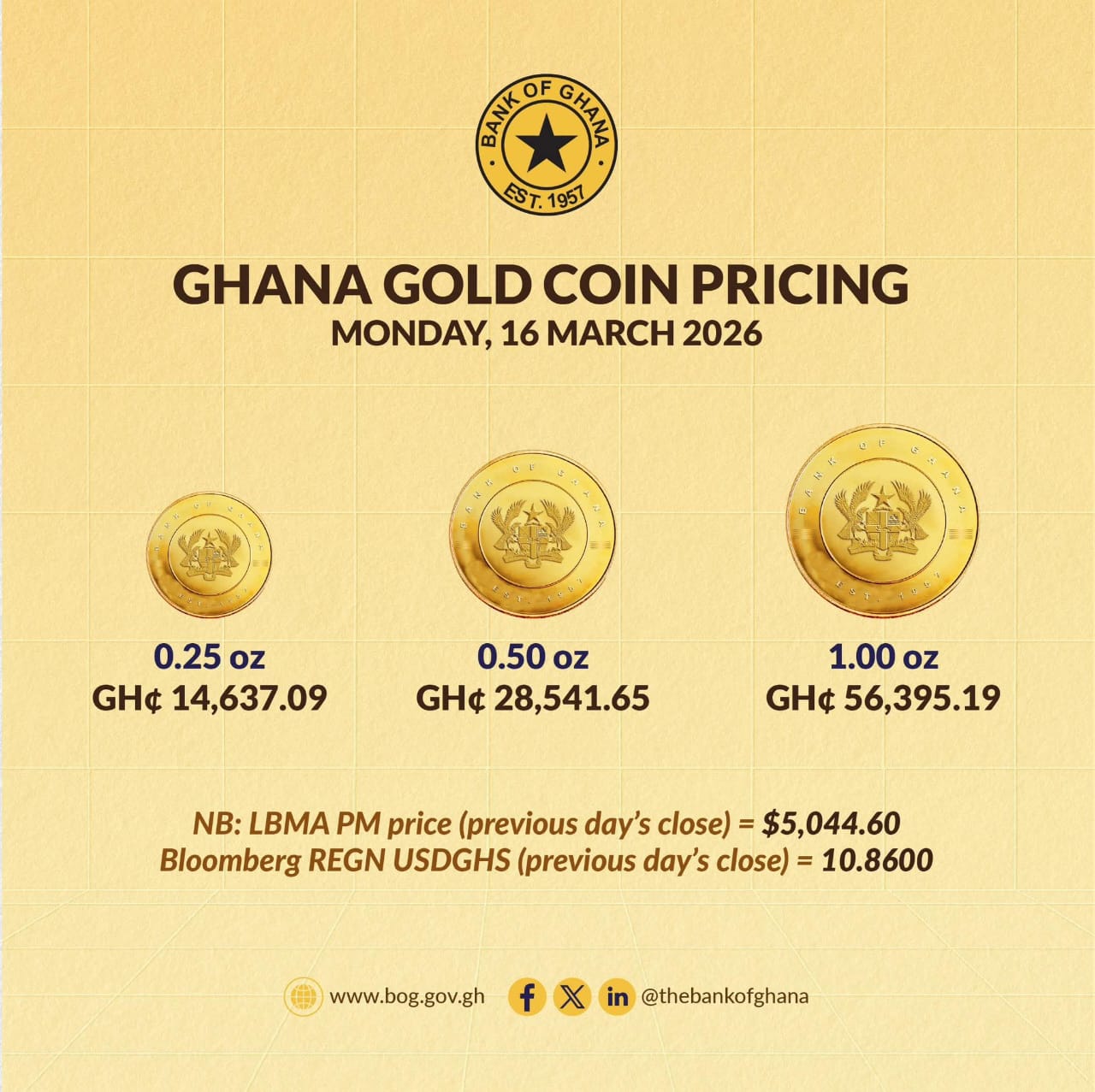
At the start of official trading on November 28, 2024, the LBMA PM Auction price stood at $2,635.40 per ounce. By March 16, 2026, the price had risen sharply to $5,044.06 per ounce—a gain of $2,408.66, or approximately 91.4%. Ordinarily, such an increase in international gold prices would result in significant gains for investors.
Cedi appreciation offsets some gains
The impact of foreign exchange market developments has moderated these potential returns. Over the same period, the Bloomberg REGN Mid-Rate declined from GH₵15.75 to GH₵10.86 per US dollar, representing a 31% appreciation of the cedi.
This strength in the local currency was supported by aggressive interventions from the central bank, which reportedly injected over $11 billion into the market to stabilize the cedi, bringing the exchange rate down from approximately GH₵14.7 in January 2025 to current levels. As a result, while gold prices nearly doubled in dollar terms, the stronger cedi has reduced the magnitude of gains for investors when converted to local currency.
Performance across coin denominations
One-ounce coin (34mm): Increased from GH₵43,328.40 to GH₵56,395.19, a gain of GH₵13,066.79 or about 30.16%.
Half-ounce coin (27mm): Rose from GH₵22,068.74 to GH₵28,541.65, gaining GH₵6,472.91 or approximately 29.33%.
Quarter-ounce coin (22mm): Appreciated from GH₵11,470.09 to GH₵14,637.09, representing an increase of GH₵3,167 or roughly 27.6%.
Investment appeal and monetary policy objectives
Launched in September 2024 under the Bank of Ghana’s Domestic Gold Purchase Programme (DGPP), the Ghana Gold Coin is part of a broader strategy to strengthen foreign reserves and reduce reliance on external financing. Beyond investment appeal, the coin serves key monetary policy objectives, allowing the central bank to absorb excess cedi liquidity from the banking system while complementing other tools, such as BoG bills and overnight deposits, in open market operations.
Expanding access to gold investment
The initiative also provides Ghanaians with a new avenue to invest in gold, a globally recognized asset known for its stability during periods of economic uncertainty. Each coin is manufactured from 99.99% pure dore gold sourced from traceable and responsibly mined deposits in Ghana, in accordance with BoG’s Responsible Gold Sourcing Framework.
Design features include the Ghana Coat of Arms on the obverse side and the Independence Arch on the reverse, symbolizing national identity and economic strength. Coins are issued in three denominations—one ounce, half ounce, and quarter ounce—and are guaranteed by the central bank.
Access and liquidity considerations
Ghana Gold Coins are available only in the domestic market and can be purchased through commercial banks using cedis. Investors typically need to open gold accounts to facilitate transactions, while banks may charge a handling fee for resale. Investors can either take physical possession of the coins or deposit them with banks for safekeeping. The Bank of Ghana guarantees buyback in cases where commercial banks are unable to facilitate resale, subject to certain conditions.
Risks and outlook
While gold remains a reliable hedge against currency depreciation, analysts caution that Ghana Gold Coin investments are not fully insulated from market risks. A decline in global gold prices could reduce the value of the investment, and currency fluctuations will continue to influence returns in local currency.
READ ALSO: BoG Rebalances Reserves with Gold Sale, Dismisses Loss Claims
However, a potential weakening of the cedi could enhance the value of gold holdings, including the Ghana Gold Coin, providing a buffer against currency depreciation. Analysts also note that the success of the programme in absorbing liquidity could reduce activity in the secondary market if liquidity tightens significantly.
Overall, the Ghana Gold Coin represents a strategic blend of investment opportunity and monetary policy innovation. While recent cedi gains have moderated returns, the product continues to demonstrate value as both a financial asset and a tool for strengthening Ghana’s macroeconomic stability.
