
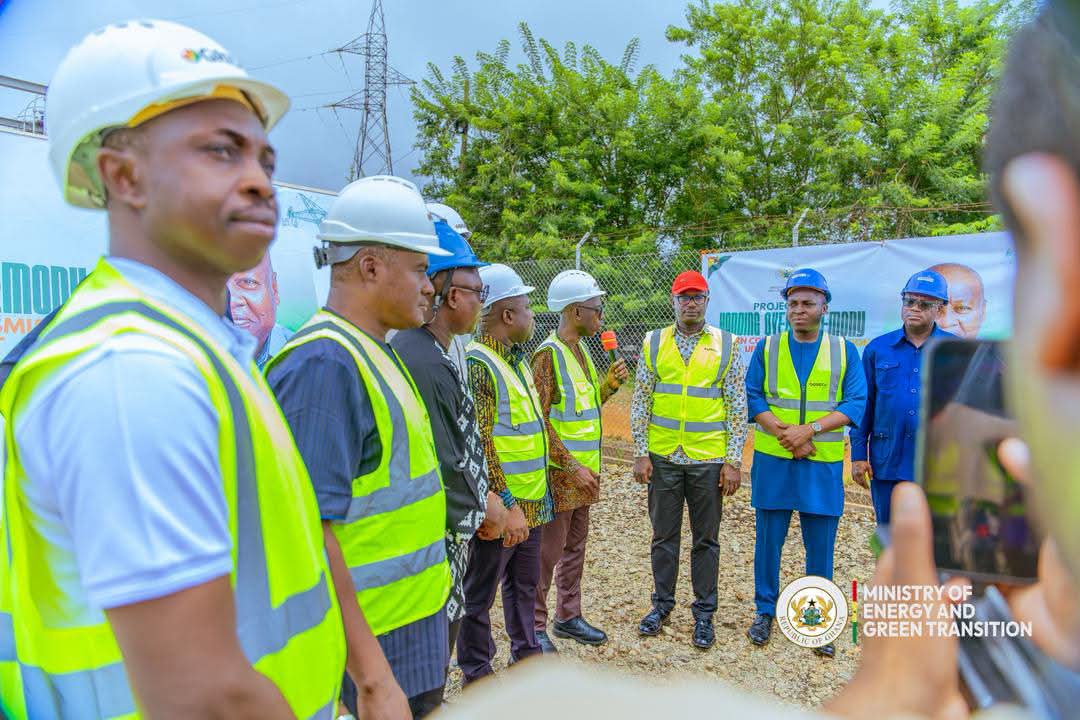
The government has launched a GH¢598 million electrification project to connect 206 communities across the Volta Region to the national grid as part of efforts to expand electricity access and stimulate economic development.
The project, being implemented under the Rural Electrification Acceleration and Urban Intensification Initiative, forms part of the government’s flagship Big Push programme.
It will cover all 18 Municipal and District Assemblies in the Volta Region and is expected to be completed within six months.
206 Communities Targeted
The project is designed to extend electricity to communities without access to the national grid while expanding infrastructure in areas requiring additional coverage.
Byes and Ways Limited has been contracted to execute the project, with the launch also marking the formal handover of the project site for construction to begin.
The government says the investment forms part of a broader strategy to accelerate rural electrification by selecting regions annually for intensive expansion of electricity infrastructure.
Four Regions Selected for First Phase
Minister for Energy and Green Transition, Dr John Abdulai Jinapor, said the government has adopted a programme under which selected regions will be targeted each year for aggressive connection of unelectrified communities.
Volta, Oti, Central and Savannah regions have been selected for the first phase.
Another four regions are expected to be targeted annually until 2030, when the government hopes to achieve universal electricity access.
Dr Jinapor said the GH¢598 million investment in the Volta Region demonstrates the government’s determination to close the electricity access gap.
He stressed that reliable electricity is critical not only to households but also to education, healthcare, businesses, agro-processing, investment, security and job creation.
Major Transmission Upgrade for Volta
The electrification drive is being complemented by major investments to strengthen electricity transmission and distribution infrastructure in the region.
The government is deploying more than 2,000 distribution transformers nationwide within the operational areas of the Electricity Company of Ghana (ECG) and the Northern Electricity Distribution Company (NEDCo).
In the Volta Region, a 45-kilometre, 161-kilovolt transmission line will be constructed from Asiekpe to Ho, together with a new 161/34.5-kilovolt Bulk Supply Point in Ho.
The transmission project is expected to improve voltage levels, enhance reliability and provide additional capacity to meet growing electricity demand along the Asiekpe-Ho-Kadjebi corridor.
The project is being undertaken by Tilt Engineering Limited and is expected to be completed within 12 months.
‘Six-Month Deadline Is Not a Suggestion’
Dr Jinapor warned the contractor executing the electrification project that the six-month completion deadline would be strictly enforced.
He stressed that the timeline was “not a suggestion” and said the Ministry would closely monitor the project to ensure that it meets required standards, delivers value for money and is completed on schedule.
The Minister called on traditional authorities, Municipal and District Assemblies and beneficiary communities to cooperate with contractors by facilitating access to project sites and helping resolve right-of-way challenges.
He also urged residents to protect electricity infrastructure against vandalism and illegal connections, observe electrical safety requirements and pay their electricity bills promptly.
Ho Transmission Works Begin
Preliminary works on the separate transmission project have already commenced.
Chief Executive Officer of Tilt Engineering Limited, Ing Samuel Adjidjornu, said a technical team had begun route surveys and engagements with communities along the transmission corridor.
The project was formally handed over to Tilt Engineering Limited at a ceremony at the GRIDCo Substation by Dr Jinapor, GRIDCo Chief Executive Officer Ing Frank Asirifi Otchere and ECG Deputy Managing Director for Special Duties, David Asamoah.
When completed, the infrastructure is expected to provide Ho and surrounding communities with additional transmission capacity and reduce pressure on existing facilities.
Volta Economic Corridor to Receive Power Boost
Volta Regional Minister James Gunu described the electrification and transmission projects as critical to the region’s economic transformation and the proposed Volta Economic Corridor.
He said reliable and sustainable electricity would be essential to attracting investment and supporting agriculture, manufacturing and emerging green industries.
According to him, improved electricity infrastructure could lower production costs, promote agricultural transformation, strengthen local value addition and attract green investments into the region.
Chiefs Pledge Support
President of the Volta Regional House of Chiefs and Paramount Chief of the Akpini Traditional Area, Togbe Dagadu IX, welcomed the projects and pledged the support of traditional authorities.
He said expanded electricity access would improve education, healthcare and commerce while providing a stronger foundation for local economic development.
He assured that traditional councils would support public education, facilitate access to project sites and help resolve challenges that may arise during implementation.
PURC to Probe Overbilling Complaints
Dr Jinapor also addressed complaints about alleged electricity overbilling, saying the Public Utilities Regulatory Commission (PURC) would independently investigate concerns raised by consumers.
The investigation is expected to determine whether customers are being billed accurately based on their actual electricity consumption.
Where faulty meters are found to be responsible for discrepancies, the affected meters will be replaced.
The GH¢598 million electrification project, together with the 45-kilometre Asiekpe-Ho transmission line, new Bulk Supply Point and deployment of additional transformers, is expected to significantly strengthen electricity access and reliability while supporting economic activity across the Volta Region.
Source: Isaac Kofi Dzokpo/capitalnewsonline.com
