
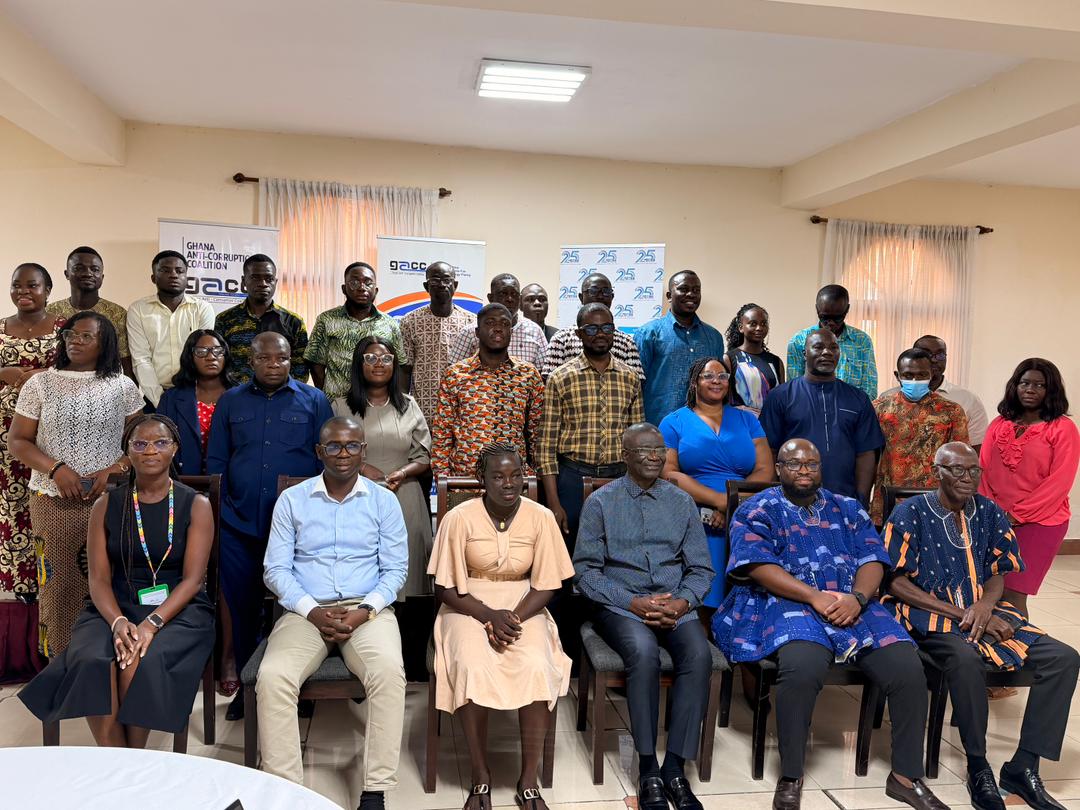
The Ghana Anti-Corruption Coalition (GACC) held a National Multi-Stakeholder Advocacy Forum to strengthen transparency and accountability in the management of petroleum revenues.
The forum was part of the project “From Disclosure to Impact – Mobilising Local Civil Society to Verify Published Extractives Data and Advocate for Equitable, Accountable Spend of Funds,” funded by the Africa Centre for Energy Policy.
The Programme Officer at GACC Samuel Harrison-Cudjoe , presented findings from three years of monitoring 68 petroleum-funded projects, highlighting the limited involvement of citizens in project planning. He described the prevalence of “parachute projects,” imposed on communities with minimal input.
Mr. Harrison-Cudjoe pointed out critical gaps, including restricted access to project information, absence of contract documents, and lack of public signage or notification about project implementation.
“Rather than focusing oil revenue on projects of national importance, funds have been spread across multiple initiatives, many of which are abandoned, delayed, or of limited impact,” he said.
He warned that weak oversight not only undermines public trust but also poses risks to national security, with corruption cited as a threat in Ghana’s National Security Strategy.

Ashanti Projects Face Transparency Challenges — ABAK Foundation
The Executive Director of ABAK Foundation Ghana and Focal Person for Asante Akyem LANET shared insights from monitoring 14 petroleum-funded projects in the Ashanti region, including school buildings, roads, electrification initiatives, and CHIPS health facilities.
He noted that national-level project designs often leave citizens without sufficient information to monitor them effectively. “We do not know the project specifications, timelines, or the contractor’s responsibilities. This lack of information makes it impossible for communities to hold implementers accountable,” he said.
He cited abandoned or incomplete projects, including roads that quickly developed potholes and health facilities that remain non-operational despite significant investment. He urged the government to involve citizens in project planning and monitoring to ensure transparency and prevent misuse of resources.
Laws Ineffective in Enforcing Accountability — NRGI
The Country Manager for Ghana at the Natural Resource Governance Institute (NRGI),Patrick Stephenson, said existing legal frameworks fail to guarantee transparency and accountability in public fund management.
“By law, contracts must be publicly disclosed, and documentation is required for all public expenditures. Yet, in practice, these rules are often ignored. Public money is treated as if it can be abused with impunity, and sanctions are weak, indirect, or institutional rather than personal,” he said.
He criticized the enforcement of Ghana’s Right to Information (RTI) Act, noting that exceptions and weak sanctions often render it ineffective. Over a 15-year period, monitoring of petroleum-funded projects covered less than 2% of over 10,000 initiatives.
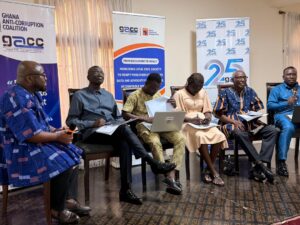
“A reset is needed, with rigid sanctions for misuse of public funds. Elsewhere, mismanagement of millions of dollars carries severe personal consequences. Here, it often goes unchecked,” Mr. Stephenson added.
PIAC Flags Lack of Local Involvement in Big Push Projects
The Senior Technical Manager at the Public Interest and Accountability Committee (PIAC), Mr. Emmanuel Gyapong, raised concerns over the limited involvement of district authorities in government-funded development projects under the Big Push initiative.
“Most projects are centrally directed. District officials often have no prior knowledge and are instructed to allow contractors to carry out works without questioning them,” he said, citing inspections in 2025 where local authorities were uninformed about planned projects.
READ ALSO: GACC Unveils 25th Anniversary Logo to Mark Silver Jubilee
He emphasized the need to align project planning with district medium-term development plans to ensure local relevance and accountability.
On enforcement, Mr. Gyapong noted that PIAC lacks powers to enforce compliance directly and relies on agencies such as the Ghana Audit Service, Environmental Protection Agency (EPA), and Office of the Special Prosecutor (OSP).
He called for stronger collaboration between central government, districts, and oversight institutions to ensure petroleum-funded projects achieve their intended objectives.

Source: Isaac Kofi Dzokpo
