
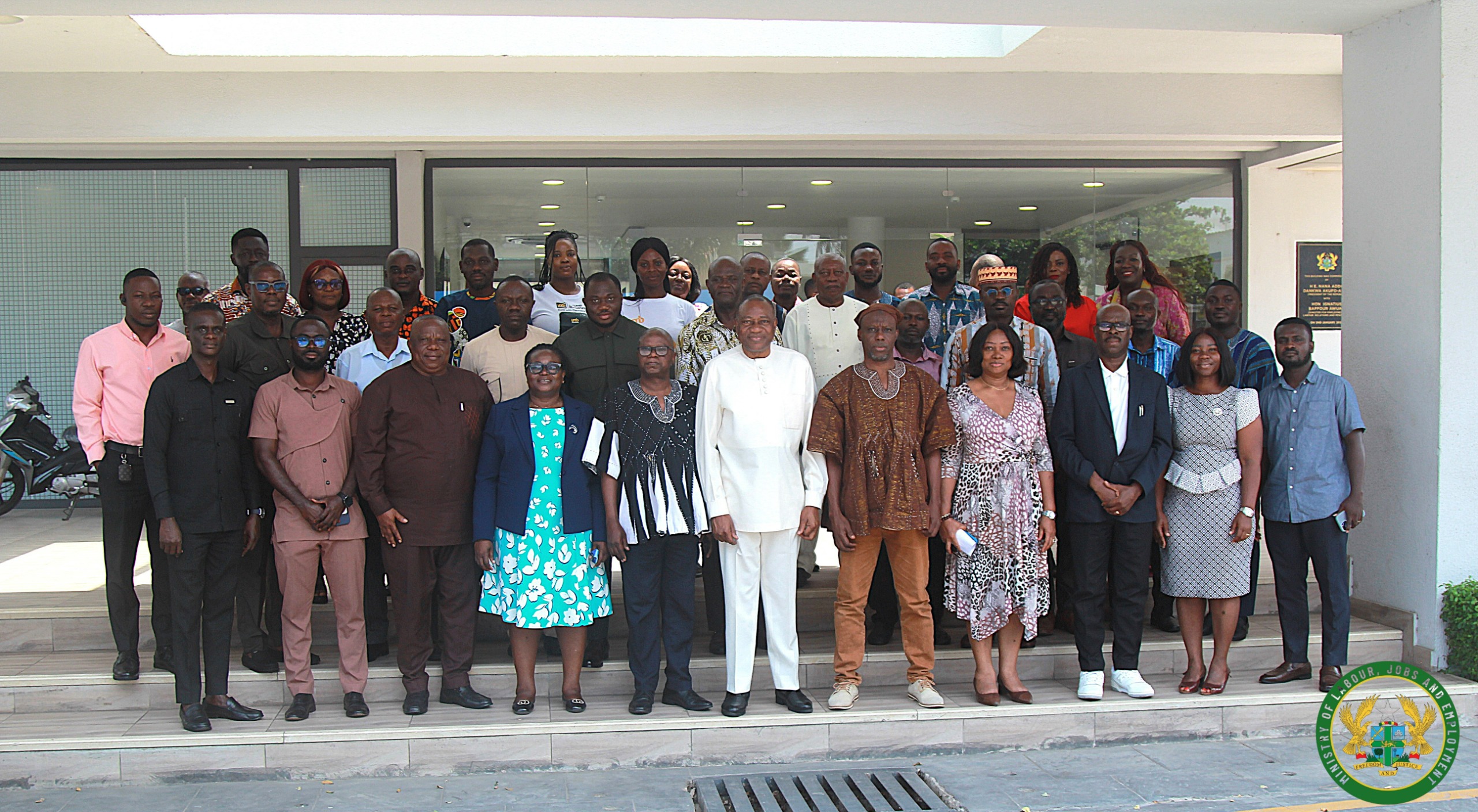
The Minister for Labour, Jobs and Employment has announced Dr. Abdul‑Rashid Hassan Pelpuo plans to introduce the National Workplace Compliance and Safety Management System (NWCSMS) as part of broad efforts to strengthen workplace inspections, improve regulatory compliance, and protect workers from occupational accidents, diseases, and other hazards.
The proposed system is expected to transform Ghana’s workplace compliance regime from a largely manual, reactive, and fragmented structure into an integrated, risk-based, and technology-driven framework for workplace registration, inspections, compliance monitoring, and enforcement.
Speaking at a stakeholder meeting on the project, the Minister said changes in the world of work, coupled with emerging occupational risks, had made it necessary for Ghana to modernise its approach to workplace safety.
“A productive economy cannot be built on unsafe workplaces. Similarly, our ambition to create sustainable and decent jobs must be accompanied by deliberate measures to protect workers from occupational injuries, diseases and other workplace hazards,” the Minister said. 
Dr. Abdul‑Rashid Hassan Pelpuo explained that rapid technological development, the expansion of the informal economy, the growth of new industries, and emerging occupational risks are placing new demands on the country’s labour administration and workplace safety institutions.
Strengthening workplace compliance and occupational safety and health should therefore not be viewed merely as a regulatory requirement, but as part of the government’s broader agenda for job creation, productivity, enterprise development, social protection, and inclusive economic transformation.
Government Targets Gaps in Workplace Inspections
The NWCSMS is designed to address longstanding challenges affecting workplace compliance administration, including inadequate and fragmented workplace data, difficulties in maintaining an accurate national profile of workplaces and enterprises, limited inspection logistics, and continued reliance on manual and paper-based processes.
Other challenges identified by the government include difficulties in monitoring compliance and enforcement actions, inadequate access to timely and reliable information, limited institutional and regional infrastructure, and weak coordination among institutions responsible for workplace safety and labour compliance.
Under the proposed system, workplace registration, compliance monitoring, occupational safety and health inspections, enforcement, reporting, and stakeholder engagement will be brought under an integrated technology-enabled framework.
The Minister clarified that the reforms are intended to change how workplace compliance is administered rather than simply converting existing manual processes into digital ones.
“The objective is not simply to introduce a digital platform. It is to transform the way workplace compliance is managed, monitored and enforced in Ghana,” the Minister said.
The new approach is expected to provide regulators with more reliable workplace data to support risk-based inspections and allow resources to be directed towards workplaces where non-compliance presents the greatest danger to workers and the public. 
Factories Inspectorate to Be Strengthened
The Department of Factories Inspectorate (DFI) will play a central role in the implementation of the NWCSMS, with the government seeking to strengthen its operational capacity to enforce occupational safety and health standards.
The Minister noted that the effectiveness of workplace safety regulation depends significantly on the capacity of inspectors and the institutions supporting them.
Under the project, the DFI is expected to receive support to improve workplace profiling and registration, risk-based inspections, field inspection logistics, compliance monitoring, and institutional coordination.
Inspectors are also expected to be provided with improved operational tools and personal protective equipment to strengthen their field operations.
This will enable inspectors to increasingly focus their attention on high-risk workplaces and areas where non-compliance poses significant threats to workers and the public. Government Turns to Private Sector Framework
The government is pursuing the project through a Public-Private Partnership (PPP) arrangement as it seeks to leverage private-sector expertise, technology, investment, and innovation.
The Minister assured that the arrangement will be guided by value for money, transparency, accountability, sustainability, data protection, and service quality.
The government will ensure that the public interest remains paramount and that private-sector participation ultimately results in measurable improvements in workplace compliance and occupational safety and health. 
Workers, Employers, and Regulators Set to Benefit
The government expects the system to deliver benefits to workers, employers, regulators, and the wider economy. For workers, the NWCSMS is expected to contribute to safer and healthier working environments and strengthen the protection of their fundamental rights.
Employers are expected to benefit from reduced administrative inefficiencies, improved access to compliance information, and a more predictable regulatory environment.
For the DFI and other regulatory institutions, the system is expected to improve operational efficiency, inspection effectiveness, data availability, and the monitoring of enforcement actions.
The government also expects to obtain better management information to support policy formulation, planning, budgeting, and resource allocation, ultimately contributing to reducing workplace accidents and occupational diseases while enhancing productivity across Ghana.
Minister Calls for Institutional Reforms
The Minister cautioned that technology alone will not deliver the expected results, stressing the need for corresponding institutional, organizational, and human resource reforms.
The project will therefore involve reviewing organizational structures, strengthening regional operations, defining roles and responsibilities, developing standard operating procedures, training personnel, and establishing monitoring and accountability mechanisms.
Inspectors and other personnel must be equipped with the competencies required to operate effectively within a modern compliance environment.
The Minister stated that the implementation of the NWCSMS will align with Ghana’s international labour obligations and relevant International Labour Organization (ILO) standards and principles, including those relating to occupational safety and health, labour inspection, social dialogue, and decent work.
The Minister called on organized labour and employers to actively support the implementation of the NWCSMS, stating the project should be treated as a shared national initiative.
The Ministry will work closely with the DFI and other relevant institutions to put in place the institutional arrangements required for successful implementation. 
Civil Service Leadership Backs Broader Institutional Reform
The Chief Director at the Office of the Head of the Civil Service, Sylvester Adzornu, stated that the NWCSMS should not be regarded simply as an information and communications technology project.
He noted that Ghana’s rapidly changing economy and labour market have created new industries, technologies, and forms of employment, bringing emerging occupational risks and increasingly complex workplace compliance requirements.
At the same time, the country’s workplace inspection system continues to face challenges including inadequate workplace data, manual processes, limited inspection logistics, insufficient operational capacity, fragmented information, and difficulties in tracking compliance and enforcement actions.
These challenges directly affect the ability of regulators to undertake effective risk-based inspections and provide timely information for policy and management decisions.
“The NWCSMS is not simply an ICT intervention. It is an institutional transformation initiative,” Mr. Adzornu said.
He explained that although the digital platform will support workplace registration, profiling, inspection planning, compliance monitoring, reporting, and enforcement tracking, the sustainability of the reforms will depend on institutional capacity, human resources, organizational structures, operational procedures, and stakeholder behavior.
The reforms will require changes in how inspections are planned and conducted, how workplace information is managed, how regulators engage businesses, and how compliance and occupational safety performance are monitored.
Adzornu Calls for Stronger DFI Capacity
Mr. Adzornu added that the reforms present an opportunity to address operational constraints confronting the Department of Factories Inspectorate.
The NWCSMS is expected to improve the Department’s ability to identify and profile workplaces, assess risks, plan inspections, deploy inspectors, monitor compliance, and follow up on corrective actions.
However, challenges relating to logistics, regional infrastructure, inspector capacity, equipment, training, and institutional arrangements must be addressed for the system to achieve its objectives. Strengthening the Inspectorate will position it to respond more effectively to the demands of Ghana’s changing world of work.
Labour and Employers Urged to Take Shared Ownership
For organized labour, the system is expected to strengthen worker protection and improve the prevention of occupational injuries and diseases.
Employers are expected to benefit from a more predictable, transparent, and efficient compliance environment while improving workplace standards and productivity.
Organized labour and employers’ associations have been urged to participate in the design, implementation, monitoring, and continuous improvement of the system. Mr. Adzornu similarly described workplace safety as a shared responsibility.
While the government is responsible for providing the regulatory and institutional framework, employers have the primary responsibility to provide safe and healthy working environments, and workers are expected to observe safety procedures, report hazards, and participate in workplace safety mechanisms.
Mr. Adzornu cautioned against allowing the NWCSMS to be perceived as a project belonging solely to the Ministry or the DFI, stressing it should be regarded as national workplace compliance and safety infrastructure serving the interests of workers, employers, regulators, and the wider economy.
System to Meet International Labour Standards
Ghana’s workplace compliance architecture must remain consistent with internationally recognized principles while responding to the country’s particular circumstances. The system should promote not only enforcement but also prevention, education, awareness, cooperation, and continuous improvement.
Targeting a National Culture of Prevention
The ultimate objective of the reforms is to move Ghana beyond a system focused primarily on inspections and enforcement towards one that prevents workplace accidents before they occur.
Employers will be expected to identify hazards before accidents happen, workers must understand their rights and responsibilities, management must invest in preventive measures, and inspectors should provide effective regulatory oversight using evidence and reliable workplace data to target areas of greatest risk.
“Our ultimate ambition should be broader than increasing the number of inspections conducted or certificates issued. We must build a culture of prevention,” the Minister said.
The success of the NWCSMS will be measured by its impact on workplace behavior, compliance levels, occupational injuries and diseases, inspection effectiveness, and overall workplace safety rather than solely by the functionality of the technology.
Stakeholders have been called upon to provide technical input into the project, support workplace registration and compliance, uphold data security, and maintain continuous dialogue to address implementation challenges.
Mr. Adzornu acknowledged that implementation will bring challenges regarding institutional readiness, change management, capacity development, technology adoption, stakeholder compliance, and sustainability, but pledged that the Ministry will work closely with all partners to ensure the reforms produce tangible improvements across Ghana.
Source: Isaac Kofi Dzokpo /capitalnewsonline.com
